
Understanding the this Keyword in JavaScript
If you ask any JavaScript developer what the most confusing part of the language is, there is a very high chance they will say the this keyword. It is famous for causing headaches, breaking code, and popping up as a trick question in almost every technical interview.
But the truth is, this is not actively trying to trick you. It just follows a very strict set of rules.
In this blog, we are going to decode those rules. We will explore what this actually represents, how it behaves in the global scope, inside objects, and inside regular functions. Most importantly, we will learn the golden rule for figuring out exactly what this is pointing to in any situation.
Let’s start with the most basic question.
What this Represents
To understand this in JavaScript, think about how we use pronouns in the English language.
Imagine reading this sentence: "Suprabhat bought a new laptop, and he loves it." You immediately know that "he" refers to Suprabhat. You don't need to repeat his name.
In JavaScript, this is exactly like that pronoun. It is a shortcut reference to an object. But which object?
Here is the ultimate secret to understanding this: this is simply the object that is calling the function right now. It does not matter where the function was written, or when it was created. The only thing that matters is how and who is executing the function at the exact moment it runs.
this in the Global Context
Let's start by looking at this completely on its own, outside of any functions or custom objects.
If you open your browser's developer console and simply type:
console.log(this);
What do you get? You will see the global window object.
In a browser environment, the window object is the massive parent object that holds everything together (like your screen width, your browsing history, and built-in tools like alert()). When you use this in the open global space, JavaScript assumes you are talking about the biggest object in the room: the global window.
this Inside Objects
The most common place you will use this is inside an object's method. A method is just a function that belongs to an object.
Let's create a profile for a user:
const user = {
    name: "Suprabhat",
    age: 23,
    greet: function() {
        console.log("Hello! My name is " + this.name);
    }
};

user.greet(); // Output: Hello! My name is Suprabhat
Why did this work perfectly? Let's apply our secret rule: Who is calling the function?
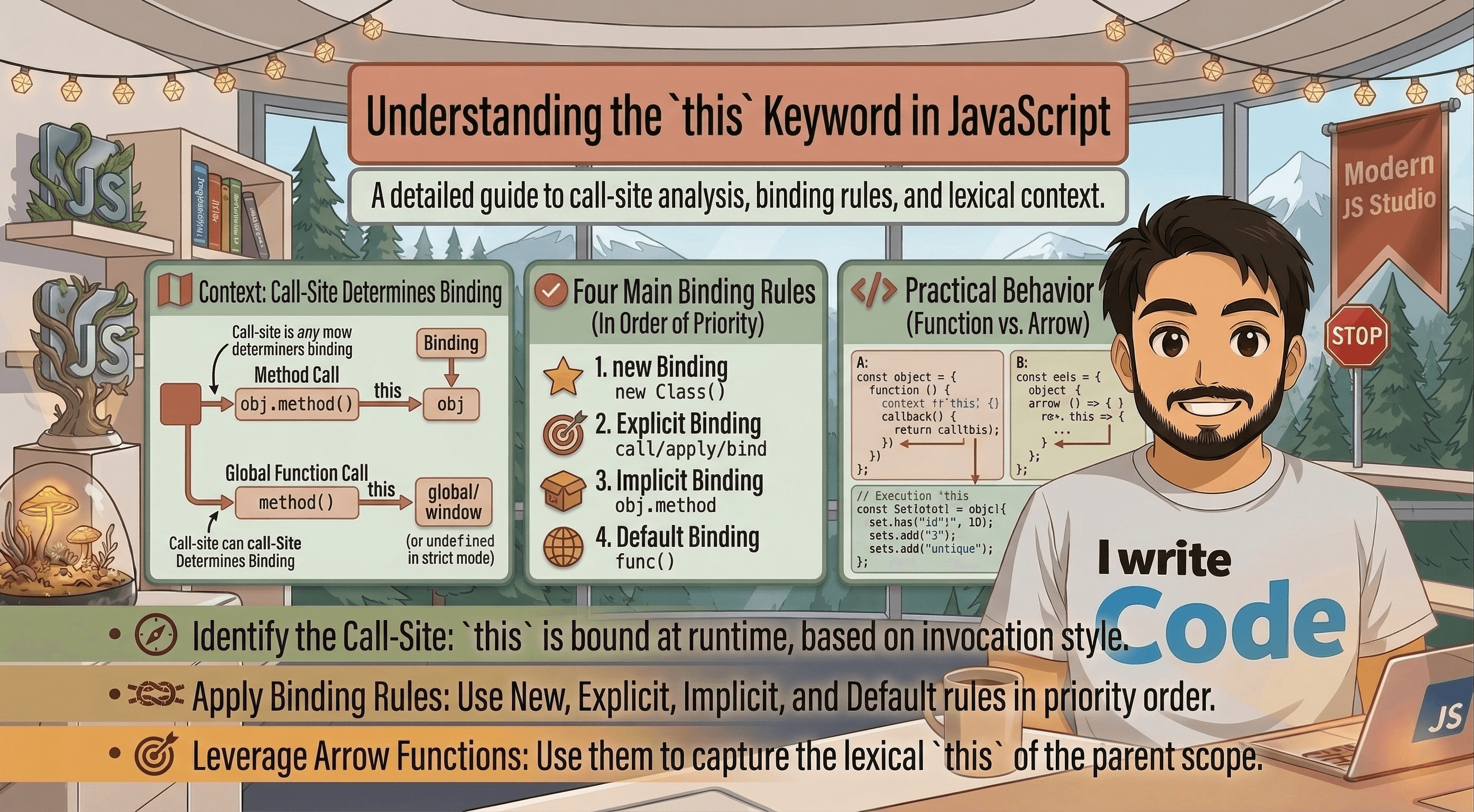
Look at the line where we execute the code: user.greet(). Notice what is to the left of the dot. It is the user object. Because the user object is the one calling the greet function, JavaScript temporarily points the this pronoun directly to user. Therefore, this.name translates perfectly to user.name.
this Inside Regular Functions
Things start to get a little weird when we use this inside a normal function that is not attached to an object.
function showThis() {
    console.log(this);
}

showThis();
If you run this code, what will be printed?
Again, ask the golden question: Who is calling the function? When you just call showThis() by itself, there is no object to the left of a dot. It is just floating out in the global space. Because of this, JavaScript defaults to the global environment. The output will once again be the global window object!
A Quick Note on Strict Mode: Because defaulting to the massive
windowobject can cause accidental bugs, modern JavaScript introduced "strict mode" ("use strict";). If you are using strict mode, JavaScript will refuse to default to the window object. Instead,thisinside a regular floating function will simply beundefined.
How Calling Context Changes this
This is the exact concept that interviewers love to test you on. You now know that this depends entirely on how a function is called. Let's see how easily we can accidentally break this by changing the caller.
Let's use our user object again:
const user = {
    name: "Suprabhat",
    age: 23,
    greet: function() {
        console.log("Hello! My name is " + this.name);
    }
};

// We assign the function to a brand new variable
const floatingGreeting = user.greet;

// Now, we call the new variable
floatingGreeting();
Output: "Hello! My name is undefined"
Wait, what happened? The function is the exact same code! Why did it lose the name?
Let's trace the execution:
We took the
greetfunction out of theuserobject and stored it in a new, independent variable calledfloatingGreeting.We executed
floatingGreeting().Who is calling the function? Look to the left of the parenthesis. There is no dot! There is no object!
Because floatingGreeting() was called as a regular, floating function in the global space, this stopped pointing to user and started pointing to the global window object. Since the global window does not have a property called name, this.name evaluates to undefined.
This proves our golden rule: this is not tied to where a function is written. It is entirely tied to the object calling it at the moment of execution.
Conclusion
The this keyword does not have to be intimidating. It is simply a dynamic pronoun that changes based on who is speaking.
If you ever get stuck trying to figure out what this represents in your code, don't panic. Just look for where the function is actually being executed with parentheses ().
If there is an object to the left of the dot (e.g.,
myObject.myFunction()),thisis that object.If there is no dot (e.g.,
myFunction()),thisis the global window (orundefinedin strict mode).
By shifting your focus away from where the code was written and focusing entirely on how it is called, the mystery of the this keyword completely disappears.