
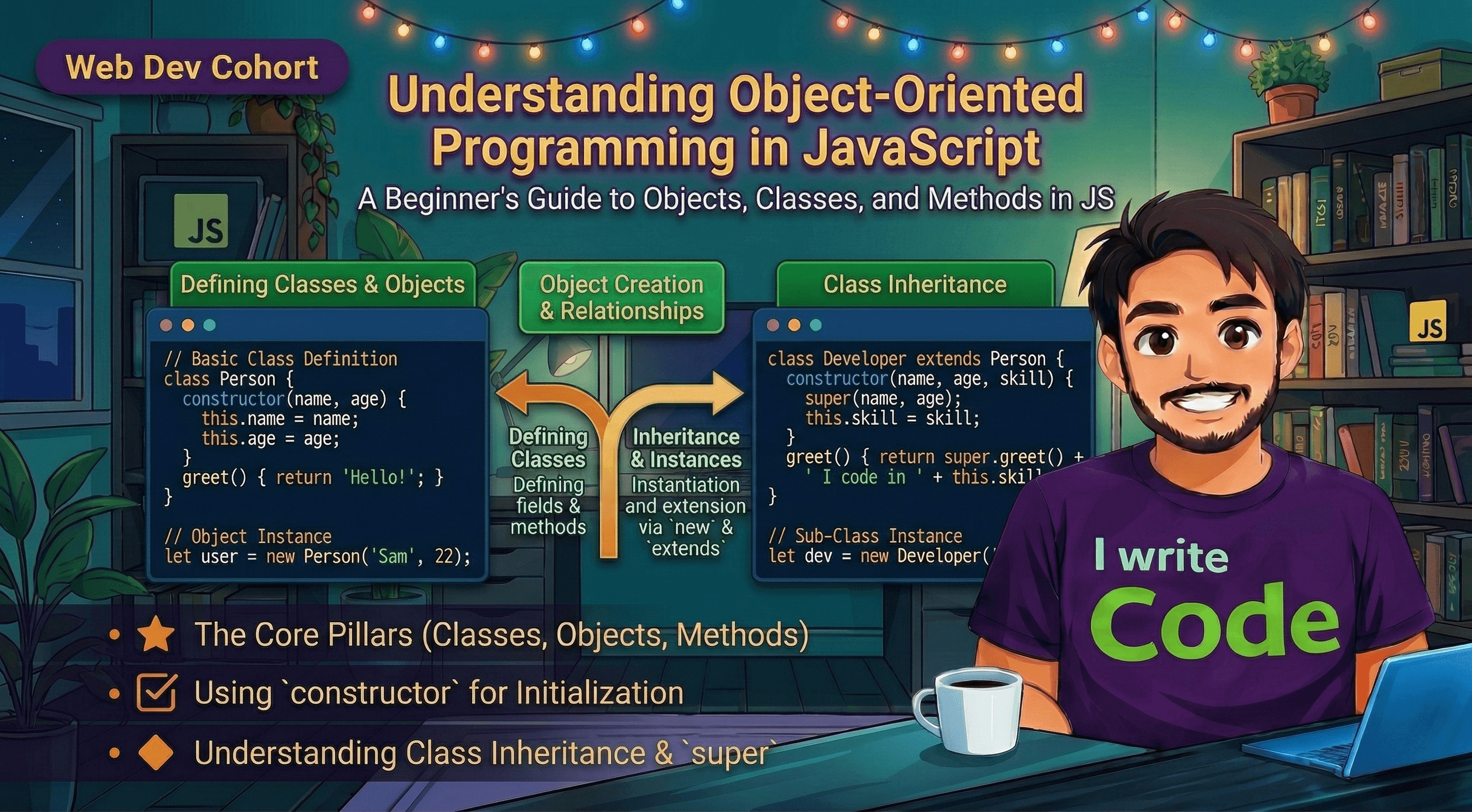
Understanding Object-Oriented Programming in JavaScript
When you first start learning to code, you usually write a simple list of instructions that run from top to bottom. But as your programs get larger, managing hundreds of variables and functions can become a disorganized mess.
This is where Object-Oriented Programming (OOP) comes to the rescue. OOP is a popular way of writing code that organizes your software around "objects" (things) rather than just a loose list of actions.
In this blog, we will break down what OOP means, understand the difference between a class and an object, learn how to create them in JavaScript, and see why this makes our code incredibly reusable.
The Real-World Analogy: Blueprints and Objects
To understand OOP, imagine you are a car manufacturer. You don't want to design every single car entirely from scratch. Instead, you create a single blueprint.
This blueprint dictates that every car will have a brand, a color, and the ability to drive. Using this one blueprint, your factory can build millions of actual cars, some red, some blue, some Fords, and some Toyotas.
In programming:
The Blueprint is called a Class.
The Actual Cars built from the blueprint are called Objects.
What is a Class in JavaScript?
A class in JavaScript is simply a template for creating objects. It defines what properties (data) and methods (actions) the objects created from it will have.
Let's look at how we write a blueprint for a Car in code:
class Car {
  // We will add properties and actions here
}
The constructor Method: Setting Up Your Object
When the factory builds a new car, it needs to paint it and put the brand logo on it right as it rolls off the assembly line. In a JavaScript class, we use a special method called the constructor to set up our object the moment it is created.
class Car {
  constructor(brandName, carColor) {
    this.brand = brandName;
    this.color = carColor;
  }
}
constructor()is automatically called when a new object is created.thisrefers to the specific object being built at that exact moment. It basically means "this specific car's brand."
Creating Objects Using Classes
Now that we have our blueprint, let's build some actual cars! To create an object from a class, we use the new keyword. This process is called instantiation (creating an instance).
let myCar = new Car("Toyota", "Red");
let yourCar = new Car("Honda", "Blue");

console.log(myCar.brand); // Output: Toyota
console.log(yourCar.color); // Output: Blue
Notice the Code Reusability: We only wrote the Car logic once, but we can easily create as many different car objects as we want without rewriting the code!
Methods Inside a Class: Adding Behavior
Objects don't just hold data; they can also do things. We can add functions inside our class to give our objects behaviors. In OOP, functions inside a class are called methods.
Let's give our car the ability to drive:
class Car {
  constructor(brandName, carColor) {
    this.brand = brandName;
    this.color = carColor;
  }

  // A method inside the class
  drive() {
    console.log(`The \({this.color} \){this.brand} is driving down the street!`);
  }
}

let myCar = new Car("Ford", "Black");
myCar.drive(); // Output: The Black Ford is driving down the street!
The Basic Idea of Encapsulation
One of the core concepts of OOP is Encapsulation.
Think of a capsule pill: it bundles different medicines together inside one shell. In OOP, encapsulation means bundling the data (like brand and color) and the methods that operate on that data (like drive()) into one single, organized unit, the class.
This keeps your code clean, prevents variables from leaking into other parts of your program, and makes it much easier to manage.
Summary
OOP is a way of organizing code around objects.
A Class is a blueprint (e.g., the idea of a Car).
An Object is the actual thing built from the blueprint (e.g., a Red Toyota).
The
constructorsets up the object's initial properties.Methods are actions the object can perform.
Encapsulation bundles data and methods together securely.
Reusability is the biggest benefit: write a class once, make infinite objects!