

Handling File Uploads in Express with Multer
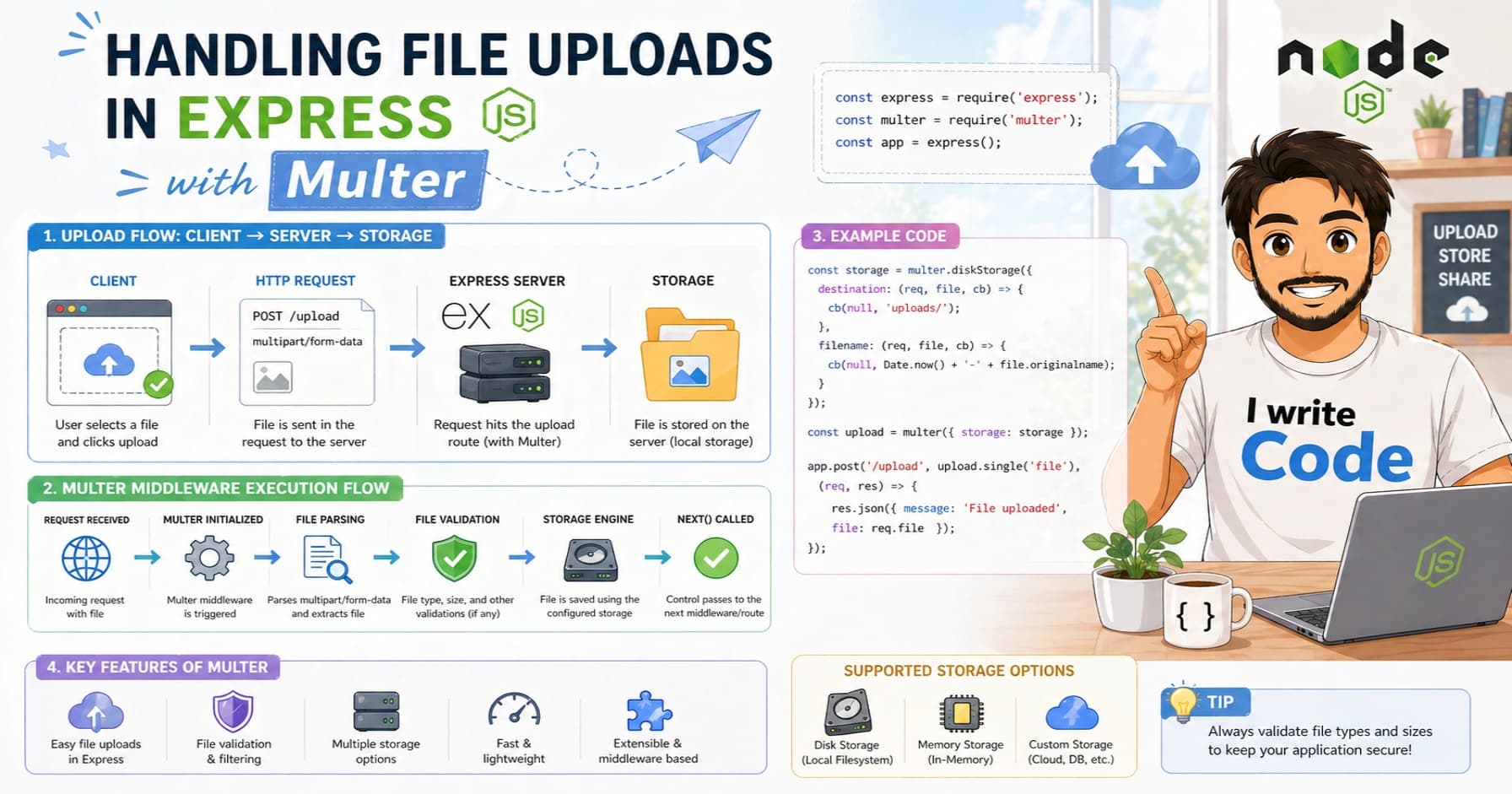
Across the web, almost every modern application needs to handle file uploads. Whether it is a profile picture, a resume, or a product image, users expect to upload files smoothly. But if you have ever tried handling file uploads in Express.js, you might have noticed that Express does not process them out of the box.
In this blog we will understand why file uploads need middleware, what Multer is, how to handle single and multiple file uploads, how to configure storage properly, and how to serve uploaded files back to users.
First, let’s understand why file uploads need middleware.
Why File Uploads Need Middleware
When a standard HTML form submits text data, browsers usually send it as application/x-www-form-urlencoded or application/json. Express can parse these formats easily using built-in middleware like express.json() or express.urlencoded(). But files are completely different.
Browsers send files using multipart/form-data. This format splits the request into multiple parts: text fields, file metadata, and the actual binary file stream. Express does not parse multipart/form-data by default. If you try to access req.body or req.files without middleware, you will get undefined.
That is where middleware comes in. It intercepts the incoming request, reads the multipart stream, extracts the files safely, and attaches them to the request object. Without this step, your server would have to manually handle binary chunks, manage temporary files, and prevent memory leaks. Middleware abstracts all of that complexity so you can focus on your application logic.
Now let’s understand what Multer is.
What is Multer?
Multer is a Node.js middleware built specifically for handling multipart/form-data. It is the most popular and widely recommended solution for file uploads in Express.
Multer parses incoming requests, extracts files, and gives you full control over where and how those files are stored. It also provides built-in safety features like file size limits, field validation, and error handling. Without Multer, you would need to write custom stream parsers, manage disk cleanup, and handle edge cases manually. Multer turns a complex, error-prone process into a few lines of clean configuration.
Before we upload anything, we need to decide where files should go.
Storage Configuration Basics
Multer gives you two main storage engines: memory storage and disk storage.
Memory storage keeps uploaded files in RAM as Buffer objects. It is fast and useful for small files or when you want to pipe data directly to cloud storage. But it is not safe for production apps because large uploads can exhaust your server memory and crash the process.
Disk storage saves files directly to your server’s file system. This is the recommended approach for most beginners and small-to-medium projects. You configure it using multer.diskStorage(), where you define two things:
destination: The folder where files will be savedfilename: How the saved file should be named
By default, Multer generates random filenames without extensions. To keep things organized, you can preserve the original extension, add timestamps, or generate unique IDs. Proper filename configuration prevents collisions and makes future file management much easier.
Now let’s understand how to handle a single file upload.
Handling Single File Upload
Once Multer is installed (npm install multer) and storage is configured, you can attach it to your routes as middleware.
For a single file, you use upload.single('fieldName'). The fieldName must match the name attribute in your HTML form or frontend API request. When the request reaches your route, Multer processes the file, saves it to disk, and attaches metadata to req.file.
You can then access useful properties like:
req.file.filename: The saved name on diskreq.file.path: The full file pathreq.file.size: File size in bytesreq.file.mimetype: The detected file type
If the field is missing or the file exceeds your configured limits, Multer throws an error that you can catch and return as a clean JSON response. This makes single file uploads predictable, secure, and easy to debug.
What if users need to upload more than one file?
Handling Multiple File Uploads
Multer handles multiple uploads smoothly without changing your core setup.
If users upload several files from the same form field, use upload.array('fieldName', maxCount). The maxCount parameter limits how many files can be sent at once, which helps prevent abuse and server overload. After processing, Multer attaches an array of file objects to req.files instead of a single req.file. You can loop through this array to save records to a database, generate access URLs, or run validation checks.
If your form contains multiple different file fields (for example, avatar and documents), you can use upload.fields(). You pass an array of objects defining each field name and its maximum count. Multer then organizes the results into req.files as an object where each key holds its own array of files.
This structure keeps complex upload forms clean and prevents route handlers from becoming messy.
Uploading files is only half the process. Users also need to access them.
Serving Uploaded Files
To serve uploaded files, you can use Express’s built-in express.static() middleware. Point it to your upload directory, and Express will automatically serve files when users request the correct URL.
For example, if your files are saved in an uploads/ folder, mounting app.use('/uploads', express.static('uploads')) allows users to access a file via http://localhost:3000/uploads/filename.jpg. The browser will render images, download documents, or play media depending on the file type.
In production, you should follow a few security best practices:
Never execute or trust uploaded files blindly
Validate file types on both frontend and backend
Restrict upload sizes to prevent disk exhaustion
Consider moving to cloud storage like AWS S3, Cloudinary, or Firebase for better scalability, CDN delivery, and automatic backups
Serving files statically works perfectly for learning and small projects, but cloud storage handles traffic spikes, security, and global delivery more efficiently as your app grows.
Conclusion
File uploads are a common requirement, but they require careful handling to stay secure, efficient, and scalable. Multer removes the complexity of parsing multipart data and gives you a clean, reliable way to manage uploads in Express. By configuring storage properly, handling single and multiple files correctly, and serving them safely, you can build robust upload features without reinventing the wheel.
Understanding this flow gives you a clear picture of how modern web apps manage user-generated content, how to protect your server from malformed requests, and how to scale your upload system as your application grows. Start with disk storage, add validation, and move to cloud providers when you are ready. The rest is just practice.