
REST API Design Made Simple with Express.js
Across the Internet, every modern web application communicates through APIs. Frontend apps, mobile clients, and third-party services all depend on predictable endpoints to exchange data. But building an API that is clean, scalable, and easy to maintain can feel overwhelming for beginners. In this blog we will understand what REST principles are and why they matter, how to map them to Express.js routes, see practical examples with proper status codes and JSON structure, and how this connects to real-world API design.
First, let’s understand what REST is and why it matters.
What is REST and why it matters
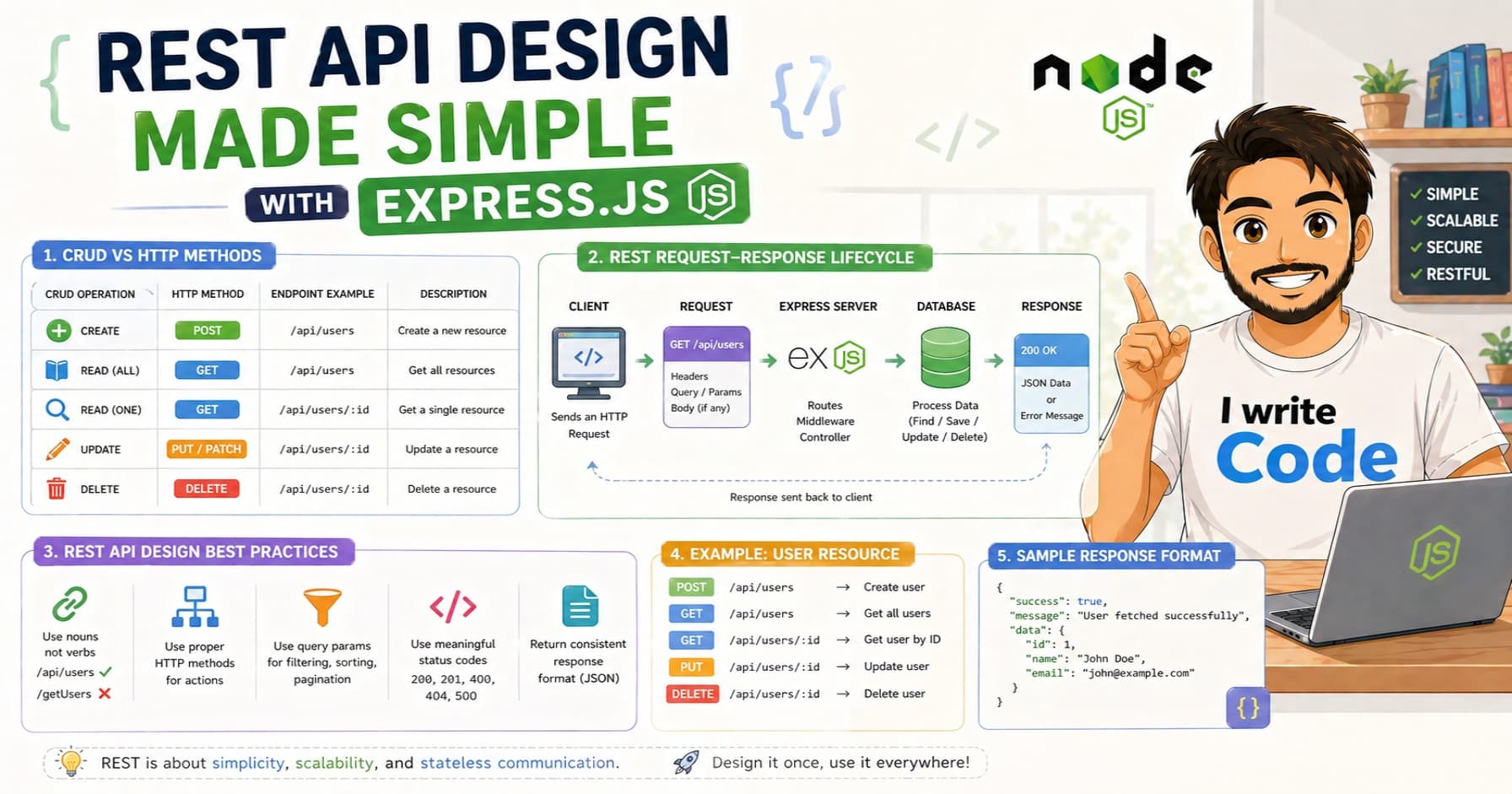
REST stands for Representational State Transfer. It is not a protocol or a framework. It is an architectural style that defines how clients and servers should communicate over HTTP. REST relies on a few core principles that keep APIs predictable and easy to work with.
Resources are the foundation. Every piece of data in your system is treated as a resource, identified by a URL. Instead of calling actions like getUser or createOrder, you work with resources like /users or /orders.
HTTP methods define the action. GET retrieves data, POST creates new records, PUT or PATCH updates existing ones, and DELETE removes them. This standardization means any developer can understand your API just by looking at the route and method.
Stateless communication ensures scalability. Each request contains all the information the server needs. The server does not store session state between requests, which makes horizontal scaling and caching much easier.
When you follow REST principles, your API becomes self-documenting, consistent, and ready for any frontend framework or mobile app.
Mapping REST principles to Express.js routes
Express.js is a minimal Node.js framework that makes routing straightforward. You can map REST concepts directly to Express route handlers.
const express = require('express');
const app = express();
app.use(express.json());

app.get('/users', (req, res) => {
  res.json({ message: 'Fetch all users' });
});

app.post('/users', (req, res) => {
  res.status(201).json({ message: 'User created' });
});

app.get('/users/:id', (req, res) => {
  res.json({ message: `Fetch user ${req.params.id}` });
});

app.put('/users/:id', (req, res) => {
  res.json({ message: `Update user ${req.params.id}` });
});

app.delete('/users/:id', (req, res) => {
  res.status(204).send();
});
This structure mirrors REST perfectly. URLs use plural nouns for collections. Route parameters like :id target specific resources. Each HTTP method triggers the correct operation. Express handles the routing logic while you focus on the business rules.
Step by step API route design
Designing a route goes beyond picking a URL. You need to handle request data, validate inputs, return proper status codes, and format responses consistently.
Use clear URL naming Stick to nouns, not verbs. /users is better than /getUsers. Use nested routes for relationships like /users/:userId/posts.
Handle request data properly POST and PUT requests send data in the request body. Express needs express.json() middleware to parse it. Always validate incoming data before processing it.
Return correct HTTP status codes Status codes tell the client what happened. Use 200 for successful GET/PUT, 201 for successful POST, 204 for successful DELETE with no body, 400 for bad requests, 404 for missing resources, and 500 for server errors.
Standardize JSON responses Keep your response structure consistent. Wrap data in a predictable format so frontend developers know exactly what to expect.
// Success response
{
  "success": true,
  "data": { "id": 1, "name": "Suprabhat" },
  "message": "User fetched successfully"
}

// Error response
{
  "success": false,
  "error": {
    "code": "VALIDATION_ERROR",
    "message": "Email is required"
  }
}
This consistency reduces frontend bugs and makes API documentation easier to maintain.
Best practices for clean API design
REST is simple in theory, but real-world projects introduce complexity. Following these practices keeps your API maintainable as it grows.
Separate routes and controllers: Keep route definitions in one file and business logic in another. This makes testing and debugging easier.
Use middleware for shared logic: Authentication, logging, and error handling should run as middleware instead of repeating code in every route.
Handle errors gracefully: Never expose stack traces in production. Create a centralized error handler that catches unhandled exceptions and returns clean JSON responses.
Version your API: Add
/api/v1/to your base path. This allows you to introduce breaking changes later without disrupting existing clients.Avoid over-fetching: Let clients request only the fields they need using query parameters like
?fields=name,email. This reduces payload size and improves performance.
These practices transform a basic Express server into a production-ready API that scales smoothly.
Connecting REST API design to real requests
When a frontend application calls your API, the same routing and response flow happens behind the scenes.
Client → Sends GET /users/123 Express → Matches route and extracts params Controller → Queries database and formats data Middleware → Adds security headers and logs request Server → Returns standardized JSON response
Let’s imagine a user named: "Suprabhat", age: 23, opens a dashboard that fetches his profile data. The frontend sends a GET request to /api/v1/users/123. Express matches the route, the controller queries the database, and the response returns a clean JSON object with his name, age, and preferences. If Suprabhat updates his email, the frontend sends a PATCH request with only the changed field. The server validates the input, updates the record, and returns a 200 status with the new data. Every interaction follows the same predictable pattern, making the system reliable and easy to debug.
Conclusion
REST API design is about consistency, clarity, and leveraging HTTP standards. Express.js makes it straightforward to map resources to routes, handle requests cleanly, and return predictable responses. By following proper naming conventions, status codes, and response formatting, you build APIs that frontend teams and external services can integrate with ease.
Always keep routes modular, validate incoming data, and centralize error handling. Version your endpoints and avoid over-fetching to keep payloads lean. Understanding this flow gives a clear picture of how servers exchange data reliably while staying fast and maintainable.
Choosing the right structure from day one saves hours of refactoring later. With Express.js and REST principles, building scalable APIs becomes a simple, repeatable process!