
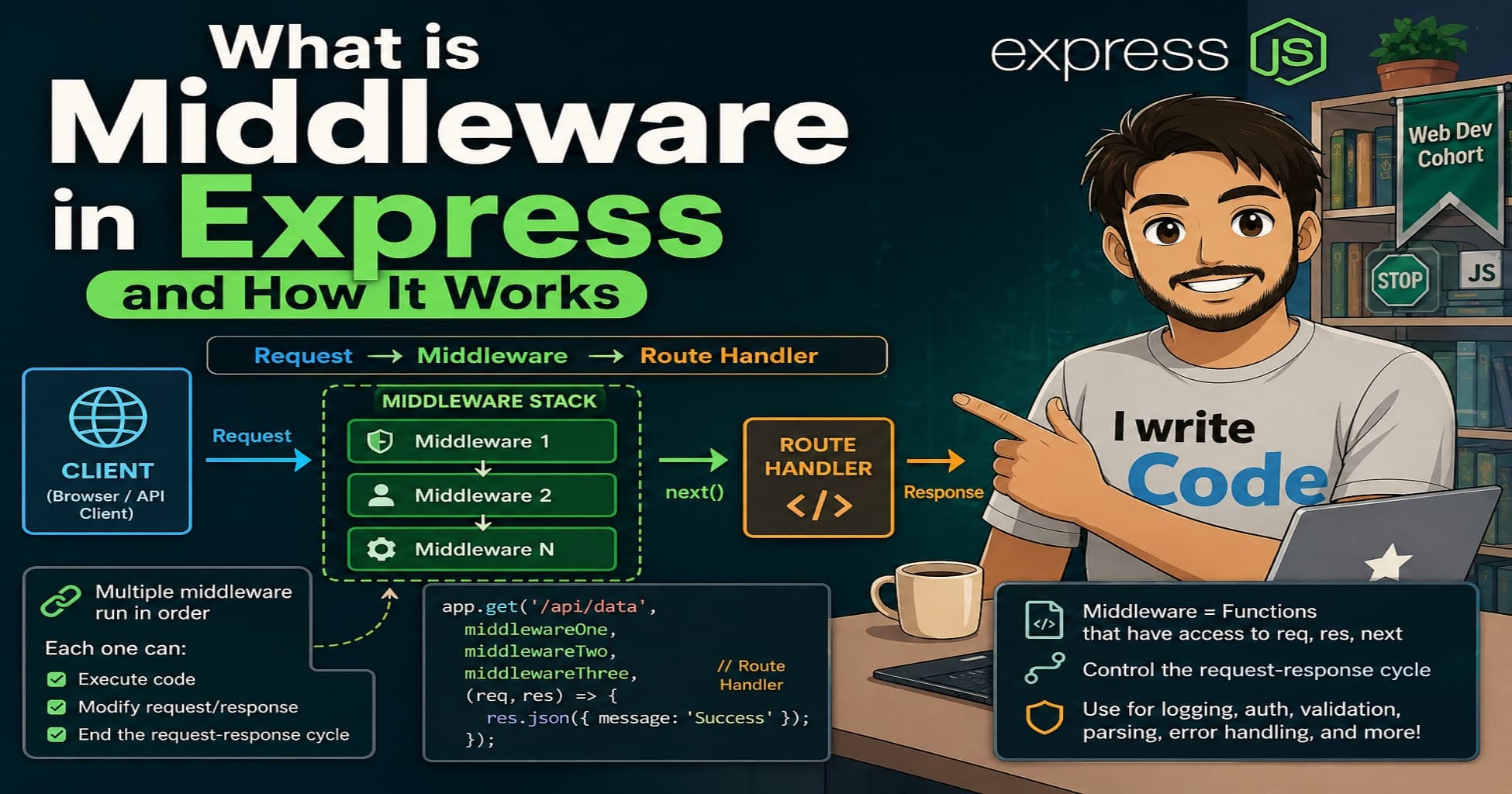
What is Middleware in Express and How It Works
If you’ve ever written an Express server, you’ve already used middleware. That app.use(express.json()) line at the top of your file? Middleware. That function checking if a user is logged in before accessing a dashboard? Also middleware.
But what exactly is middleware? Why does Express rely on it so heavily? And why does the order you write it in matter so much?
In this beginner-friendly guide, we’ll demystify Express middleware, walk through where it fits in the request lifecycle, break down its types, and build real-world examples you can use in your own projects.
What is Middleware in Express?
At its core, middleware is just a function. But it’s a function with special access. Every middleware function receives three arguments:
req(the incoming request object)res(the outgoing response object)next(a function that passes control to the next middleware)
Middleware sits between the raw HTTP request and your final route handler. It can:
Read or modify
reqandresExecute code (like logging or validation)
End the request-response cycle early (by sending a response)
Pass control to the next middleware using
next()
Think of middleware like a series of security checkpoints at an airport. Your request is the passenger. Each checkpoint inspects, stamps, or redirects the passenger before they finally reach the gate (your route handler).
Where Middleware Sits in the Request Lifecycle
When a request hits your Express server, it doesn’t jump straight to your route logic. Instead, it flows through a middleware pipeline:
Request arrives at the server
Passes through global/application middleware
Passes through router-specific middleware (if matched)
Reaches the final route handler
Response is sent back to the client
At any point in this chain, a middleware can:
Modify the request (e.g., parse JSON, attach a user object)
Reject the request (e.g., return
401 Unauthorized)Log data, set headers, or handle errors
Call
next()to continue the journey
If no middleware sends a response and next() is never called, the request will hang until it times out. This is why understanding the flow is critical.
The Role of the next() Function
The next() function is the traffic controller of Express middleware. It tells the server: “I’m done processing. Move to the next function in line.”
Here’s what happens depending on how you use it:
next()→ Moves to the next matching middleware or routenext(err)→ Skips all regular middleware and jumps to error-handling middlewareForgetting
next()→ The request hangs forever (a common beginner bug)
app.use((req, res, next) => {
  console.log("Request received!");
  next(); // Without this, the browser will spin indefinitely
});
next() is what makes middleware composable. You can chain dozens of functions together, and Express will execute them in order, as long as each one calls next().
Why Execution Order Matters
Middleware runs exactly in the order you define it. This isn’t a suggestion; it’s the architecture.
If you place authentication middleware before express.json(), your auth logic might try to read req.body before it’s parsed, resulting in undefined. If you place a catch-all route before your API routes, those API routes will never be reached.
// ✅ Correct order
app.use(express.json());           // Parse body first
app.use(authMiddleware);           // Then check auth
app.get("/dashboard", handler);    // Finally handle route

// ❌ Broken order
app.use(authMiddleware);           // Tries to read unparsed body
app.use(express.json());           // Too late
Always arrange middleware from broad to specific, and from data preparation to business logic.
Types of Middleware in Express
Express categorizes middleware based on where and how it’s applied. Here are the three main types you’ll use daily:
1. Application-Level Middleware
Bound to the entire app instance using app.use() or app.METHOD(). Runs on every request (or a specific path if provided).
app.use((req, res, next) => {
  console.log(`\({req.method} \){req.url}`);
  next();
});
2. Router-Level Middleware
Works exactly like application-level middleware, but is bound to an instance of express.Router(). Ideal for modularizing features.
const router = express.Router();

router.use((req, res, next) => {
  console.log("Router middleware triggered");
  next();
});

router.get("/users", (req, res) => res.send("User list"));
app.use("/api", router);
3. Built-In Middleware
Express ships with a few essential middleware functions out of the box:
express.json()→ Parses incoming JSON payloadsexpress.urlencoded({ extended: true })→ Parses form dataexpress.static("public")→ Serves static files like CSS, images, or JS
You don’t need to install anything extra. Just plug them in at the top of your server file.
Real-World Middleware Examples
Theory is great, but middleware shines in practice. Here are three production-ready patterns you’ll use constantly.
1. Request Logging
Track every incoming request for debugging or analytics.
app.use((req, res, next) => {
  const timestamp = new Date().toISOString();
  console.log(`[\({timestamp}] \){req.method} ${req.url}`);
  next();
});
2. Authentication Guard
Protect routes by verifying a token before allowing access.
const authMiddleware = (req, res, next) => {
  const token = req.headers.authorization;

  if (!token) {
    return res.status(401).json({ error: "No token provided" });
  }

  // In real apps, verify JWT or session here
  req.user = { name: "Suprabhat", age: 23, role: "admin" };
  next();
};

app.get("/profile", authMiddleware, (req, res) => {
  res.json({ message: `Welcome, ${req.user.name}` });
});
3. Request Validation
Ensure required fields exist before hitting your database.
const validateUser = (req, res, next) => {
  const { name, email } = req.body;

  if (!name || !email) {
    return res.status(400).json({ error: "Name and email are required" });
  }

  next();
};

app.post("/register", express.json(), validateUser, (req, res) => {
  res.status(201).json({ message: "User registered successfully" });
});
Notice how each middleware does one thing well, then passes control forward. That’s the Express philosophy.
Conclusion
Middleware is the backbone of Express. It’s how you parse data, secure routes, log activity, handle errors, and structure your backend without cluttering your route handlers. Once you understand the request pipeline, the power of next(), and why order matters, you’ll stop fighting Express and start leveraging it.
Start small. Write a logger. Add a validation check. Experiment with moving middleware up and down your file to see how the flow changes. The more you play with the pipeline, the more intuitive it becomes.
Express doesn’t force a rigid architecture. It gives you a flexible, composable system where every function has a clear job. Middleware is that system in action.