
Why Node.js is Perfect for Building Fast Web Applications
If you’ve ever wondered how modern web applications handle thousands of simultaneous users without crashing or slowing down, you’ve likely stumbled upon Node.js. Originally released in 2009, Node.js transformed JavaScript from a browser-only language into a powerful server-side runtime. But what truly sets it apart isn’t just its language, it’s its architecture.
In this guide, we’ll break down exactly what makes Node.js fast, demystify concepts like non-blocking I/O, event-driven architecture, and the single-threaded model, explore where Node.js shines in production, and look at real-world companies that trust it to power their platforms. Whether you’re a beginner or transitioning from another backend technology, this post will give you a clear, practical understanding of how Node.js works under the hood.
What Makes Node.js Fast?
When developers say “Node.js is fast,” they rarely mean raw computational speed. Languages like C++ or Rust will always outperform JavaScript in CPU-heavy tasks. Node.js’s speed comes from how it handles concurrency and I/O operations.
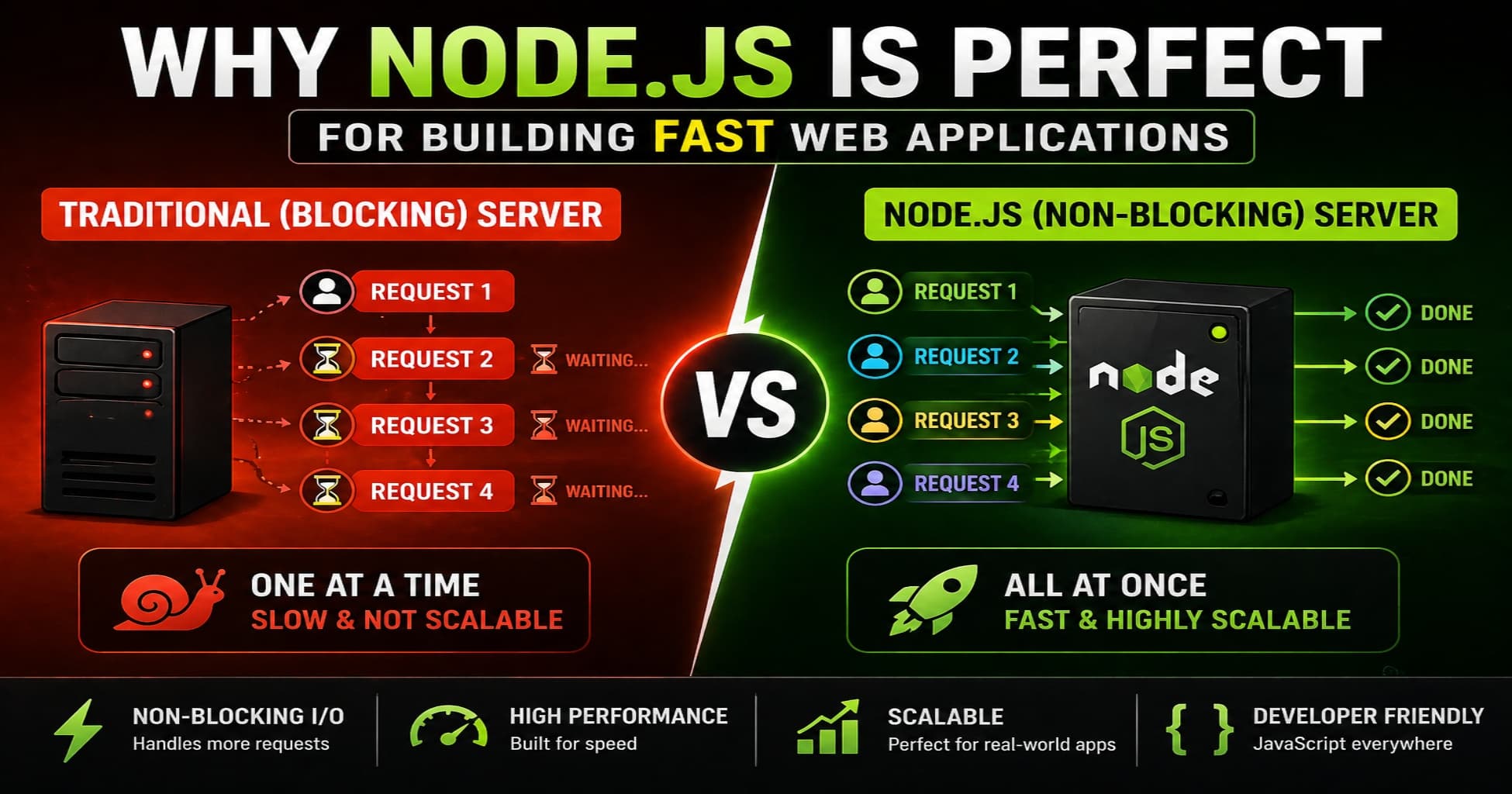
Traditional server models (like Apache or early Java servers) often use a multi-threaded approach: each incoming request gets its own thread. While this works for low traffic, threads consume memory and CPU. Under heavy load, thread creation and context switching become bottlenecks.
Node.js takes a completely different approach. Instead of spawning threads for every request, it uses a single-threaded, event-driven, non-blocking I/O model. This allows it to handle tens of thousands of concurrent connections with minimal overhead. Let’s unpack each of these pillars.
The Single-Threaded Model Explained
At first glance, “single-threaded” sounds like a limitation. How can one thread possibly handle multiple users at once?
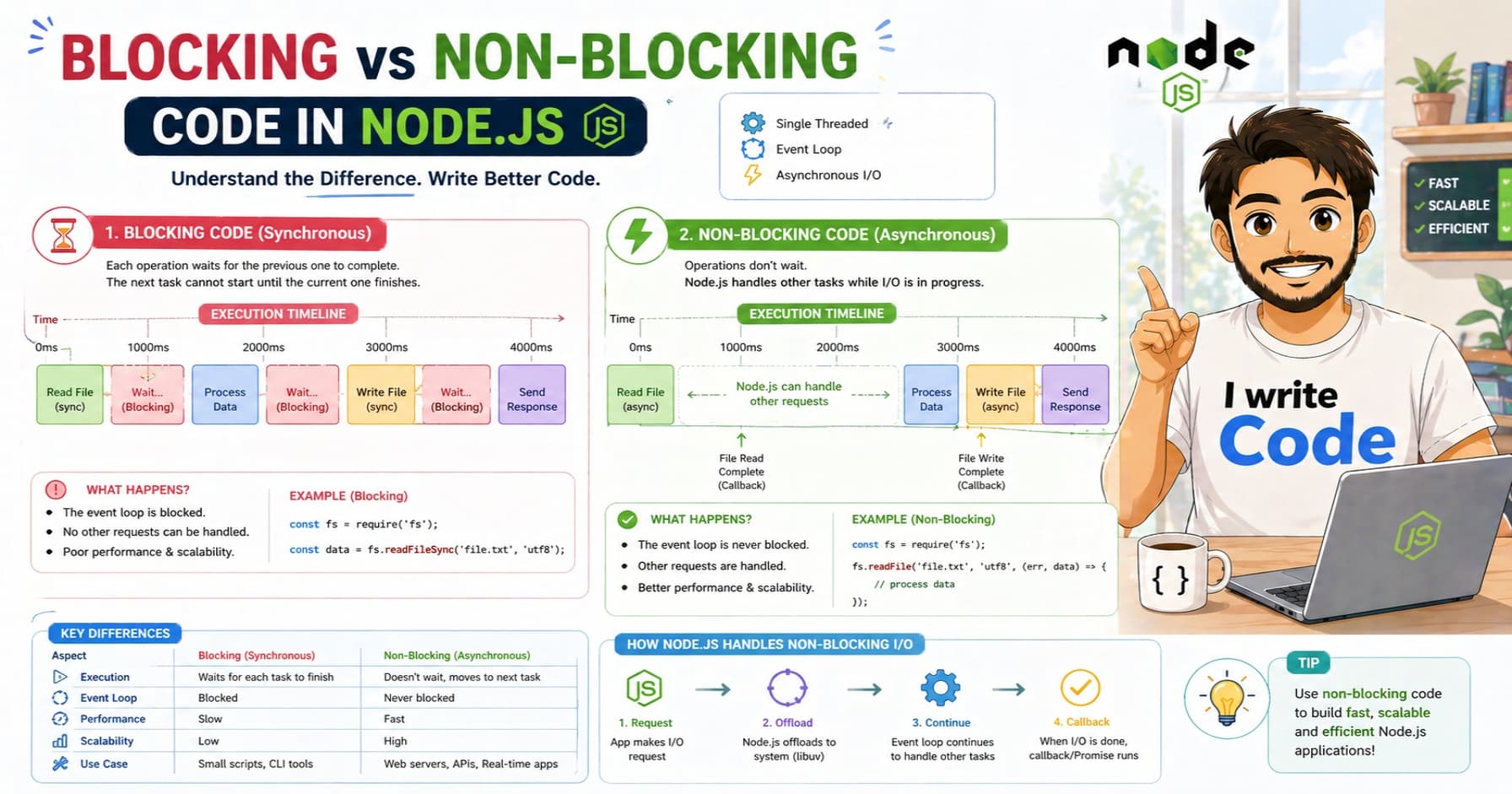
In Node.js, JavaScript execution runs on a single main thread. This means your code executes line by line, without parallel JS execution. But here’s the catch: Node.js doesn’t use that thread to wait for slow operations like database queries, file reads, or network requests.
Think of it like a skilled receptionist at a busy clinic. Instead of personally performing every medical test (which would take hours), the receptionist logs requests, hands them off to specialists, and continues checking in new patients. When a test is complete, the specialist notifies the receptionist, who then delivers the results.
Under the hood, Node.js uses the V8 JavaScript engine (the same one powering Chrome) to compile JavaScript into highly optimized machine code. The single thread acts as an orchestrator, not a worker. Heavy lifting is delegated to the system via a C++ library called libuv, which manages a background thread pool specifically for I/O tasks.
Non-Blocking I/O: The Secret Sauce
I/O (Input/Output) refers to any operation that interacts with external resources: reading files, querying databases, making HTTP requests, or streaming data. These operations are inherently slow compared to CPU instructions.
In a blocking model, the thread pauses and waits until the I/O operation finishes. Nothing else can happen during that wait time. In a non-blocking model, Node.js initiates the I/O task, immediately moves on to the next line of code, and registers a callback to handle the result later.
Here’s a simplified example:
// Non-blocking database fetch
fetchUserFromDB((err, user) => {
  if (err) return console.error(err);
  console.log(user); // e.g., { name: "Suprabhat", age: 23, }
});

console.log("This runs immediately, without waiting for the DB!");
Notice how the second console.log executes right away. Node.js doesn’t sit idle while the database responds. It continues processing other requests, and when the database returns the data, the callback fires. This non-blocking behavior is what allows Node.js to maintain high throughput under heavy I/O load.
Event-Driven Architecture: How Node.js Stays Responsive
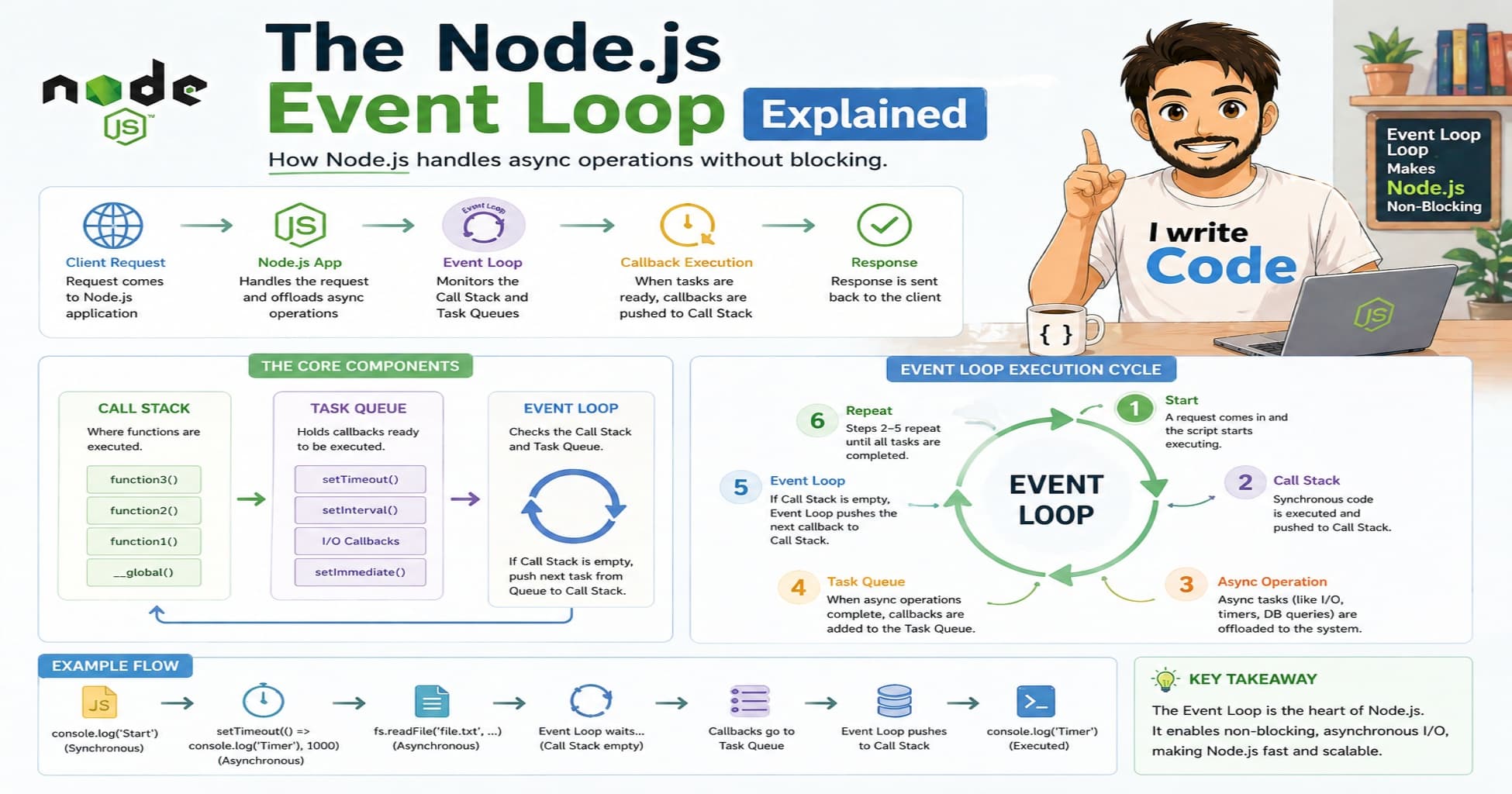
Non-blocking I/O is powerful, but it needs a system to track and manage all those pending operations. That’s where the event-driven architecture and the Event Loop come in.
The Event Loop is a continuously running mechanism that checks for completed asynchronous tasks and executes their associated callbacks. It operates in phases:
Timers: Executes
setTimeoutandsetIntervalcallbacks.Pending Callbacks: Handles I/O callbacks deferred from previous loops.
Poll: Retrieves new I/O events and executes their callbacks.
Check: Runs
setImmediatecallbacks.Close: Handles cleanup callbacks (like closing sockets).
Returning to our clinic analogy: the Event Loop is the receptionist’s clipboard. It constantly checks which test results are ready, matches them to the correct patient, and delivers them in order. Because the loop never blocks, Node.js stays responsive even when juggling thousands of pending requests.
Important caveat: The Event Loop can be blocked by CPU-intensive JavaScript code (like complex loops or heavy data processing). If your main thread is stuck calculating, it can’t check the clipboard. That’s why Node.js is optimized for I/O-bound workloads, not CPU-bound ones.
Where Node.js Performs Best
Understanding Node.js’s architecture makes it easy to identify its ideal use cases:
✅ Real-Time Applications: Chat apps, live collaboration tools, and multiplayer games benefit from Node’s low-latency, bidirectional communication (often paired with WebSockets).
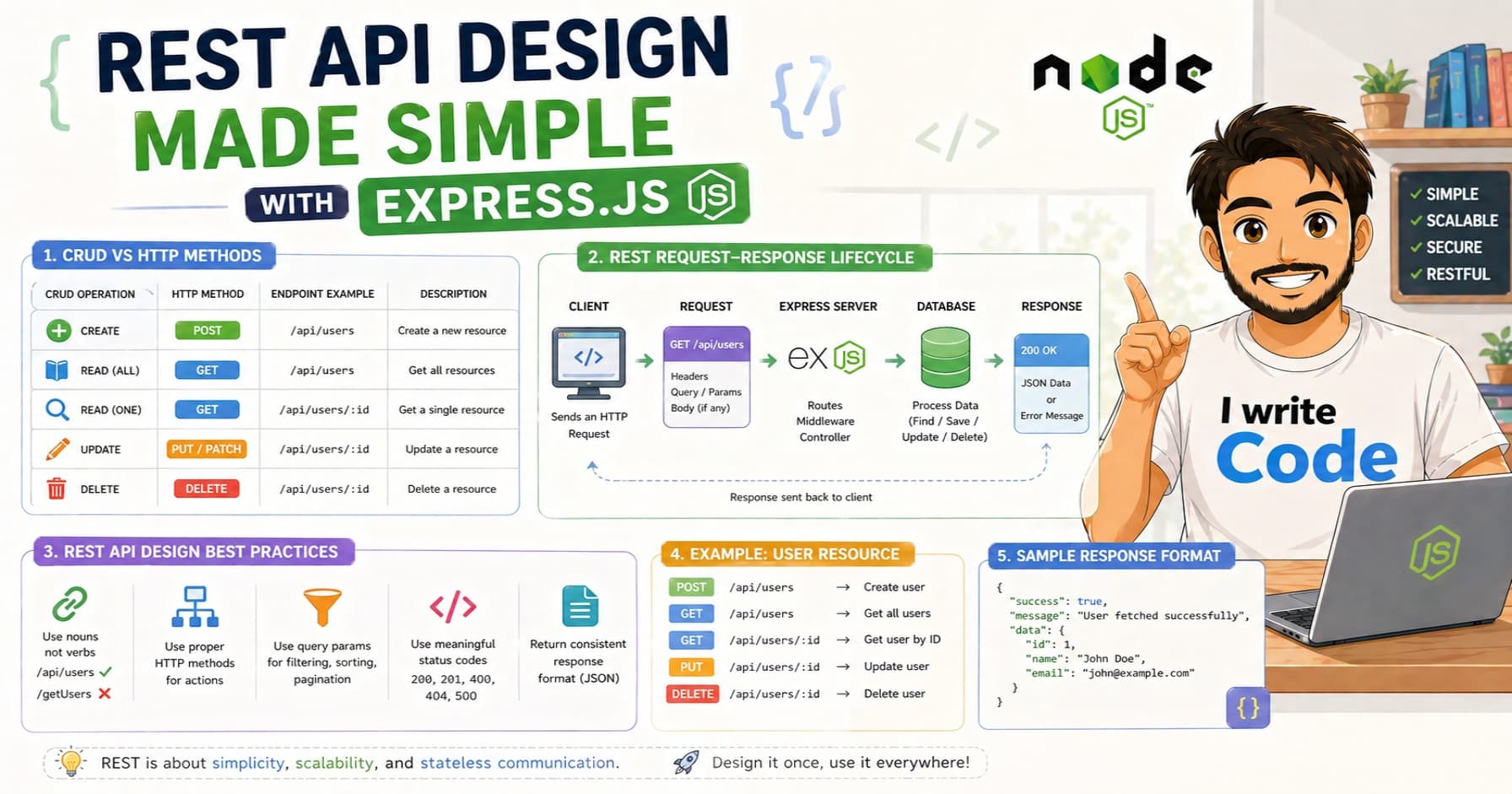
✅ APIs & Microservices: Lightweight, fast, and JSON-native, Node.js is perfect for building RESTful or GraphQL APIs that handle high request volumes.
✅ Streaming Applications: Video/audio streaming, file uploads, and data pipelines work smoothly because Node processes data in chunks without buffering everything in memory.
✅ Single Page Applications (SPAs): Serving assets and handling routing for React, Vue, or Angular frontends aligns perfectly with Node’s event-driven model.
✅ High-Concurrency, I/O-Heavy Workloads: Dashboards, notification systems, and proxy servers thrive under Node’s non-blocking architecture.
⛔ Where to Avoid Node.js: CPU-intensive tasks like video encoding, machine learning model training, or complex mathematical simulations. For these, consider offloading to worker threads, external services, or languages better suited for parallel computation.
Real-World Companies Using Node.js
Node.js isn’t just a developer favorite, it’s battle-tested at scale. Here’s how industry leaders leverage it:
🔹 Netflix: Migrated to Node.js to unify their frontend and backend stack, reducing startup time by 70% and enabling faster A/B testing.
🔹 PayPal: Replaced Java with Node.js for their web layer, cutting response times in half and doubling requests per second with fewer servers.
🔹 LinkedIn: Switched their mobile backend to Node.js, reducing server count from 30 to 3 while improving performance and developer velocity.
🔹 Uber: Uses Node.js for its massive real-time dispatch system, handling millions of concurrent connections with minimal latency.
🔹 Walmart: Adopted Node.js to handle Black Friday traffic spikes, successfully managing over 500 million page views without downtime.
🔹 NASA: Utilizes Node.js for data-intensive applications and internal tooling, proving its reliability even in mission-critical environments.
These companies didn’t choose Node.js for raw speed, they chose it for scalability, developer efficiency, and exceptional handling of concurrent I/O operations.
Conclusion
Node.js isn’t fast because it computes faster. It’s fast because it waits smarter. By combining a single-threaded JavaScript execution model, non-blocking I/O, and an event-driven architecture, Node.js eliminates the traditional bottlenecks of server-side programming. It thrives in environments where concurrency, real-time communication, and I/O efficiency matter more than heavy number crunching.
As you begin your Node.js journey, remember: architecture dictates performance. Use it for APIs, real-time apps, and microservices. Offload CPU-heavy tasks. Embrace asynchronous patterns. And most importantly, let the Event Loop do what it does best—keep your application responsive, scalable, and efficient.
Ready to build your first non-blocking server? Start small, experiment with callbacks and promises, and watch how Node.js handles concurrency with elegance. The modern web runs on event-driven systems, and now you understand exactly why.